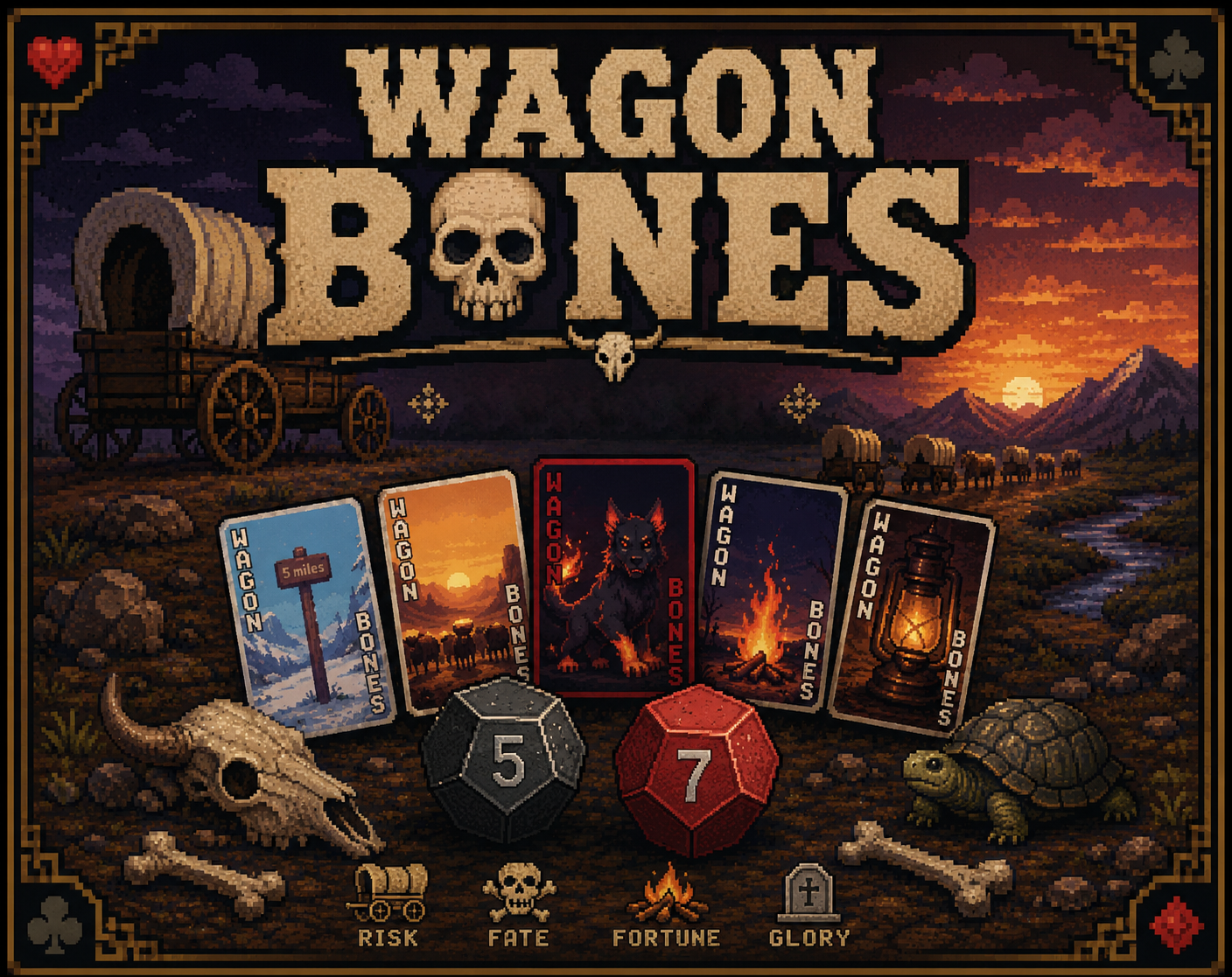
Wagon Bones
Wagon Bones
Basically a Balatro clone with dice and an Oregon Trail skin — a hobby project for fun, not for sale. Roll dice, build hands, collect equipment, and travel the frontier one leg at a time.
About The Game
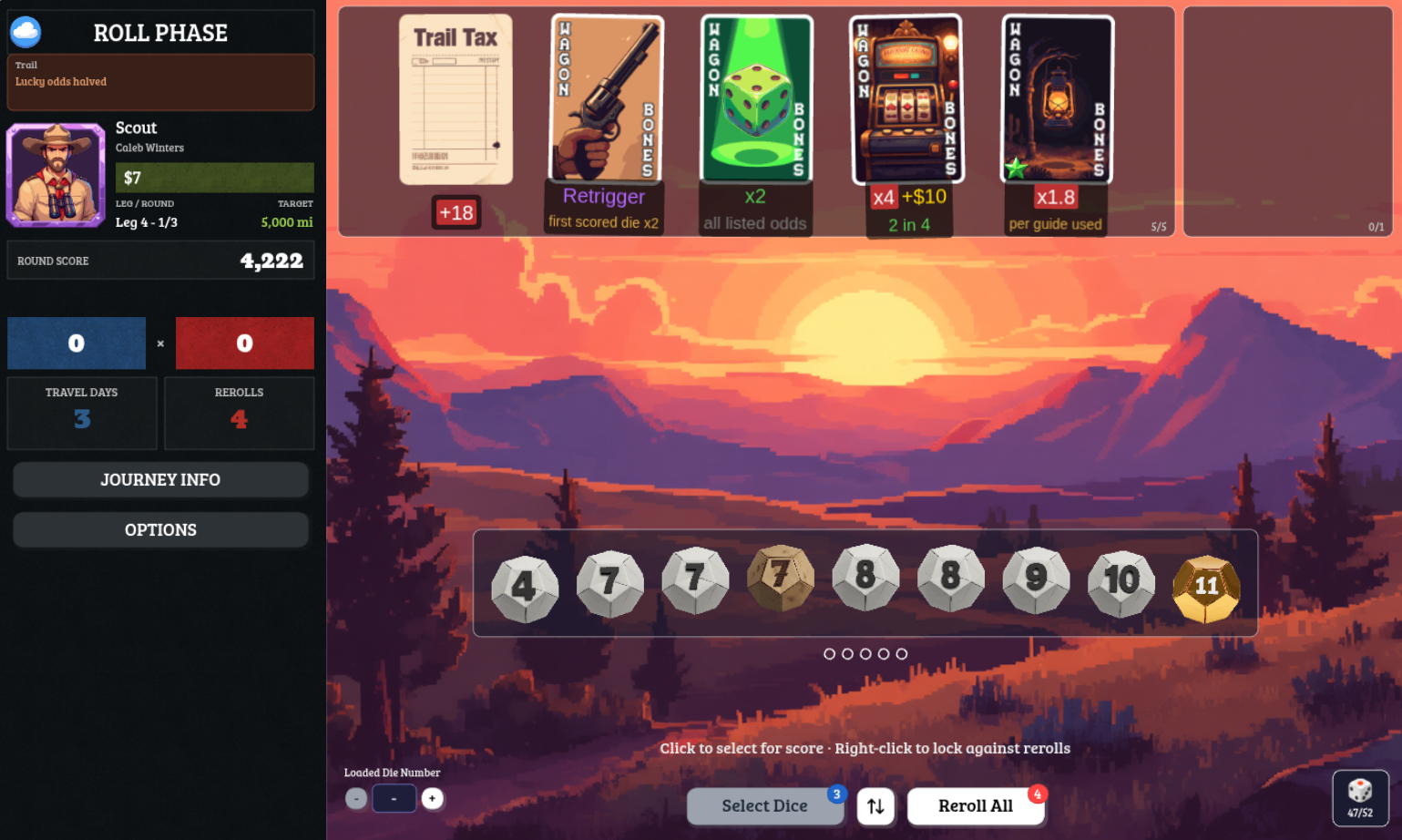
Instead of playing cards, you roll d12 dice (values 1–12). Each day you draw 8 dice from your pouch, roll them, and score up to 5. Pips on scored dice count as base miles traveled. Multipliers work like Balatro’s mult system.
You must reach each landmark within a limited number of days (4 by default, with 4 rerolls per day), and each leg of the journey raises the mile target. Start in Independence, Missouri and travel 8 legs to Oregon City. Each leg has 3 rounds — two trail rounds plus a boss showdown. After the story route, endless mode can continue up to leg 39.
Game Mechanics
What’s the same as Balatro
- Chips × mult scoring — base miles plus additive mult, then multiplied by xMult equipment
- Equipment (jokers) — persistent items that modify scoring with conditional triggers and synergies
- Trail Guides (planets) — level up specific hand types for more base miles and mult
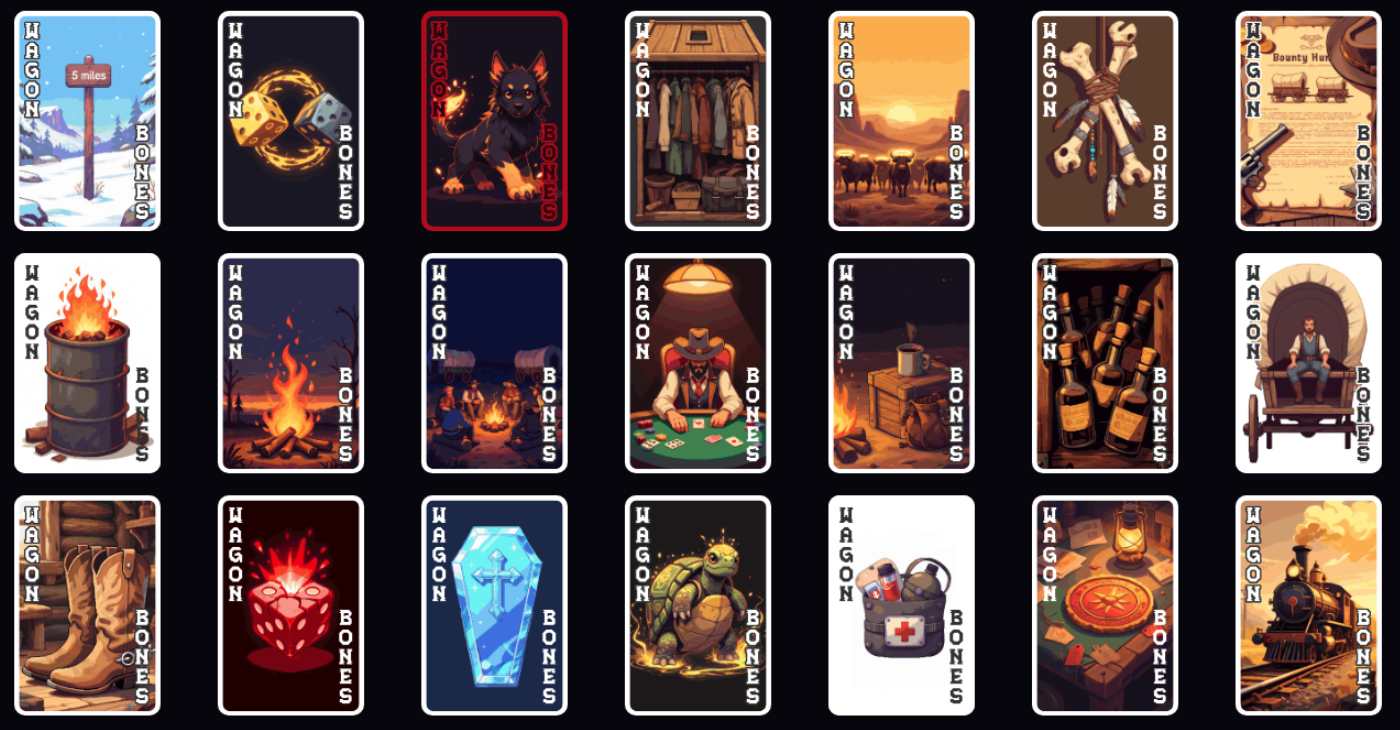
- Supply Cards (tarot) — one-use cards that enhance dice, manipulate your collection, or earn money
- Frontier Encounters (spectral) — rare, powerful cards that reshape your run
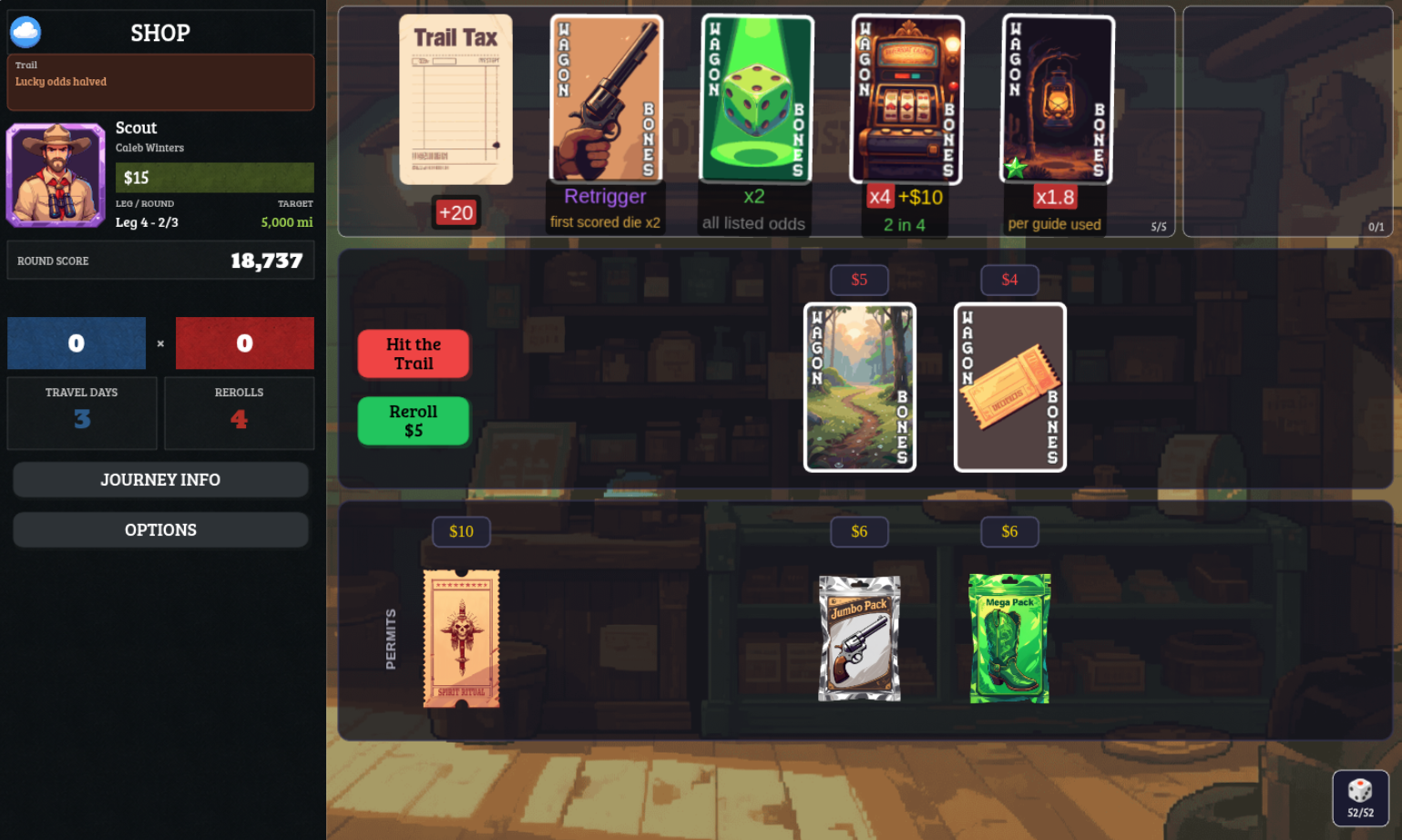
- Shop economy — buy equipment and consumables, reroll the shop, earn interest on savings
- Escalating blinds — each round within a leg and each new leg raises the score you need to beat
What’s different from Balatro
- Dice instead of cards — no suits or face cards; hand types are based on pairs, straights, and n-of-a-kind
- Days instead of hands — you have a limited number of days to reach your destination each round, with rerolls resetting each day
- Dice management — there is no discard feature. You play the dice you are dealt from your pouch, so the emphasis is less on a lean deck of perfect cards and more on building a varied collection of strong dice you hope to draw often. Supply cards are a bit more generous with dice enhancements so you can improve your collection quickly.
- Equipment order matters — equipment and dice effects apply left-to-right during scoring, and cards can be drag-reordered
- Oregon Trail theme — landmarks, professions, trail events, and a journey structure instead of poker blinds
How To Play
The game loop
- Pick a profession — each starting character changes your run (rerolls, money, slots, shop behavior)
- Pick a difficulty — higher difficulties tighten the economy, raise mile targets, and add modifiers like cursed equipment or fewer rerolls
- Play a round — on the round-select screen, play or skip the current blind. Skipping earns a trail tag reward instead of fighting that round. Beat the mile target within your day limit (up to 4 travel days by default), then collect your payout
- Trail event — after each cleared round, a narrative event offers choices that can buff your run, cost money, or reshape your dice and equipment
- Shop — spend your earnings on equipment, supply cards, trail guides, permits, and booster packs (some tags can skip the next shop visit)
- Repeat — return to round select for the next blind on the current leg. Clear all 3 rounds to reach the next landmark, until Oregon City or endless mode ends your run
Bosses and rounds
Each leg has 3 rounds: two trail rounds, then a boss showdown on round 3. Trail rounds use the normal rules; the boss adds a special modifier for that fight only.
Examples: The Inspector shrinks your hand size each day, The Marathon quadruples the mile target, The River only counts straights and high value, and The Trickster downgrades trail knowledge on every hand you play. Bosses unlock as you travel farther; you can see which one is waiting before you commit. Skip a boss round for a tag if the modifier is too punishing, or reroll the boss assignment with the right permit.
Each travel day
- Roll — your pouch deals 8 dice; roll them (4 rerolls per round by default)
- Score — lock in 1 to 5 dice as your hand. If multiple hand types match, the harder hand wins
- Advance — scored miles add to your round total. Run out of days before hitting the target and the run is over
Light strategy
- Build toward a hand type — trail guides and equipment that reward pairs, straights, or n-of-a-kind pay off when your dice collection supports that plan
- Order your equipment — left-to-right scoring order matters; put setup effects before payoffs and xMult last
- Enhance your dice — supply cards and frontier encounters are the main way to add bonus pips, auras, and retriggers to individual dice
- Manage money — interest on savings adds up; balance buying power now vs. saving for bigger shop hits later
- Read the boss — the third round on each leg is a boss with a special rule; adjust your plan or skip for a tag reward if the modifier is too harsh
Credits
Inspiration
Let’s be honest: this is basically a Balatro clone. LocalThunk’s game is the whole blueprint — shop loop, blinds, jokers, tags, mult math, all of it. Wagon Bones swaps cards for d12 dice and wraps it in Oregon Trail flavor. It’s a personal project I made for fun; I have no plans to sell or monetize it.
How it was built
The game was built heavily with AI assistance, from assets to game logic to UI. Development started in GitHub Copilot (mostly Claude Opus 4.6), then moved to Cursor with a mix of GPT-5.5 and Composer 2.5.
Tech stack: Phaser 4 (game engine), SolidJS (host UI), TypeScript, Vite, and Bun.
Assets
- Card art and dice sprites — generated with qwen-image / qwen-image-edit
- Background music — royalty-free tracks from Pixabay (Pixabay Content License):
- “Gaming Game Video Game Music” by Viacheslav Starostin (Pixabay: original_soundtrack) — 2:01
- “Retro Arcade Game Music” by MondaMusic — 1:18
- Sound effects — from The Spriters Resource (Balatro SFX). The game is 100% free; if there’s a licensing issue I’m happy to swap them out.
Leave a comment
Log in with itch.io to leave a comment.